Ever sat down after a long day at work, ready to unwind, only to realize your living room seating leaves your lower back aching and your legs straining? Choosing the right seat for your home goes beyond simple interior decor; it directly impacts how well you relax, recover, and manage everyday fatigue.
When shopping for a modern recliner, you will quickly notice that not all seats move the same way. Understanding the mechanics of a recliner chair or a multi-seater recliner sofa ensures you pick a design that fits your physical needs, living room space, and daily routine.
Understanding the Core Differences in Motion
The primary distinction between these three seating styles lies entirely in their base mechanisms and how they move. While all three let you kick your feet up and lean back, the engineering underneath changes the entire seating experience.
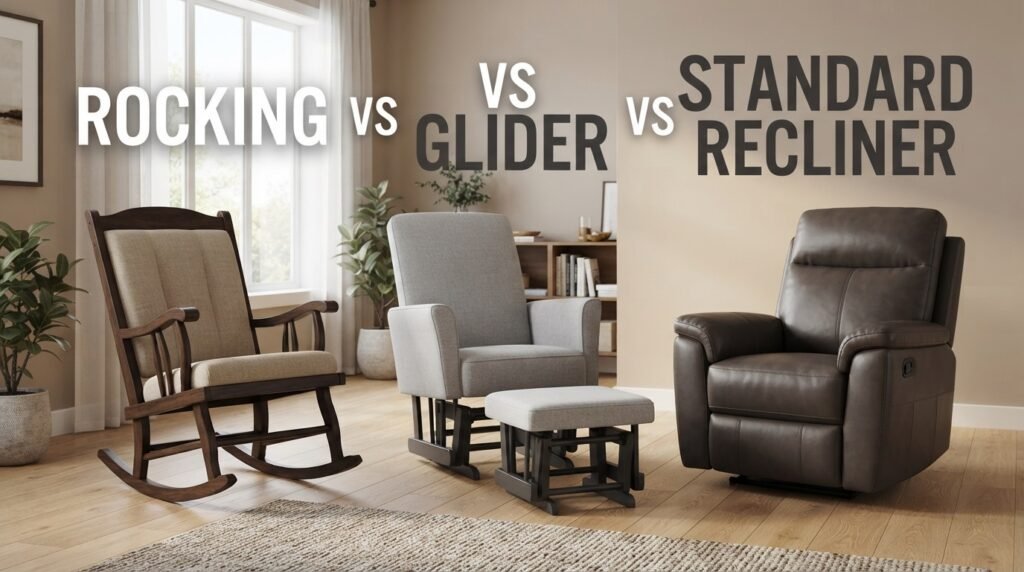
What is a Standard Recliner?
A standard recliner relies on a stationary, heavy-duty frame fixed directly to the floor. When you pull a side lever or push back against the backrest, a mechanical linkage pops the footrest up and tilts the back cushion downward.
- Stationary Base: It stays firmly in one spot on your living room floor.
- Footprint Efficiency: Because it does not slide or rock, it requires less rear clearance from the wall than rocking models.
- Stability: Ideal for households looking for a sturdy, fixed seat with zero swaying motion.
What is a Rocking Recliner?
A rocking recliner combines traditional motion with modern reclining technology. It sits on curved base tracks, allowing the entire chair to sway back and forth when upright. Once you engage the reclining mechanism, the rocking function locks or disengages so you can recline safely.
- Gentle Motion: The traditional rocking arc helps soothe tired muscles or rock infants to sleep.
- Dual Purpose: Functions as both a soothing rocker and a full-length lounge chair.
- Space Requirement: Needs extra clearance behind it so the rocking arc and reclining backrest do not scrape against living room walls.
What is a Glider Recliner?
A glider recliner moves on a fixed track mechanism rather than curved legs. Instead of tilting back and forth in an arc, a glider glides smoothly back and forth on a flat plane.
- Fluid Motion: Provides a smoother, quieter, and more controlled motion than traditional rockers.
- Modern Mechanism: Often features a sleek, enclosed base that prevents pets or children from reaching moving parts underneath.
- Versatile Placement: Works exceptionally well in tighter urban apartments where smooth, linear movement is preferred over wide rocking arcs.
Comparing Comfort, Space, and Daily Living
Selecting the right piece for your TV lounge or bedroom requires balancing your room dimensions with your personal comfort habits.
Space Management in Pakistani Homes
Urban living rooms often feature compact layouts where space is at a premium.
- Standard Recliners fit snugly against walls with minimal rear clearance, making them easy to position in smaller spaces.
- Rockers need generous breathing room behind them to accommodate the rocking arc. Placing them too close to a wall limits their primary function.
- Gliders offer a middle ground, moving straight back and forth on a contained mechanical track, which makes them easier to fit into moderate living room setups without wasting precious floor area.
Durability and Maintenance
Daily usage in a busy household puts heavy demands on furniture mechanisms.
- Stationary Frames experience fewer moving friction points, making standard models exceptionally durable over years of daily family use.
- Motion Bases (rockers and gliders) contain springs, bearings, and tracks that benefit from occasional inspection and gentle handling, ensuring they remain squeak-free through years of movie nights and afternoon naps.
Also Read: The Ultimate Recliner Buying Guide
How to Choose the Right Seating for Your Home
Making the final decision comes down to evaluating your physical routine and the specific room where the seat will live.
- Assess Your Space: Measure the exact floor area and check rear wall clearance before buying a rocking model.
- Evaluate the User: If you need gentle, repetitive motion to soothe a baby or relax restless legs, lean toward a smooth glider. If you prefer absolute stillness and sturdy lower back support, stick to a stationary frame.
- Match Your Interior: Look for upholstery fabrics, such as durable textured cloths or supple leathers—that handle local seasonal shifts well, staying breathable during humid summer months and cozy in cooler winter evenings.
Read More: Manual vs Motorized Recliner
Frequently Asked Questions
Can a rocking recliner be placed directly against a wall?
No. Rocking models require several inches of clearance behind them to move through their rocking arc safely. Placing them flush against a wall will restrict movement and potentially damage the backrest.
Is a glider recliner better for nurseries?
Yes. Gliders are widely favored for nurseries because their linear, track-based movement is quieter and smoother than traditional rockers, helping prevent sudden jolts that might wake a sleeping infant.
Do standard recliners take up less space than motion recliners?
Generally, yes. Because standard models do not rock, glide, or require swing clearance underneath or behind the base, they maintain a tighter footprint in compact living areas.
How do I maintain the mechanism of a motion recliner?
Keep the tracks and hinges clean from dust and debris. Periodically check for loose bolts, and apply a light silicone lubricant to moving metal joints if you notice any squeaking during operation.
Are multi-seater recliner sofas available in rocking or gliding styles?
Typically, rocking and gliding mechanisms are built into individual armchairs. Multi-seater sectionals or sofas usually feature end seats with standard push-back or powered reclining mechanisms, keeping the middle sections stationary.