When designing or reupholstering furniture, it’s easy to get swept up in fabric swatches and color palettes. But while the fabric provides the look, the foam provides the life. Foam is the structural soul of your furniture; it dictates whether a sofa remains a cozy retreat for a decade or turns into a saggy, uncomfortable “hammock” within six months.
One of the most common mistakes in the industry is choosing foam based on “feel” alone without looking at the specs. If you want to create pieces that maintain their integrity and comfort, you need to master the science of foam density.
1. Density vs. Firmness: The Golden Rule
The biggest misconception in furniture manufacturing is that “high density” means “hard.” This is a myth.
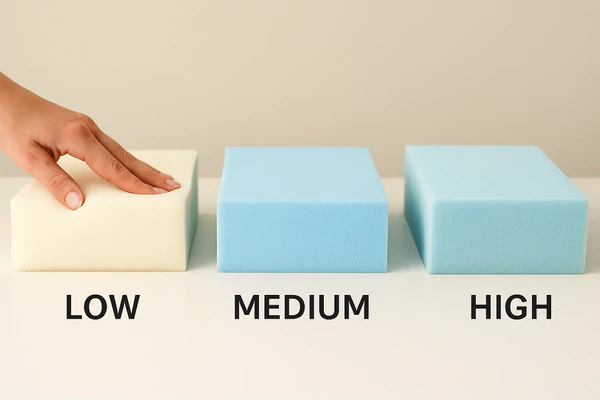
- Density (Durability): Measured in $kg/m^3$ (or $lb/ft^3$), density refers to how much actual material is in the foam versus air. Higher density means more material, which translates to a longer lifespan and better resistance to sagging.
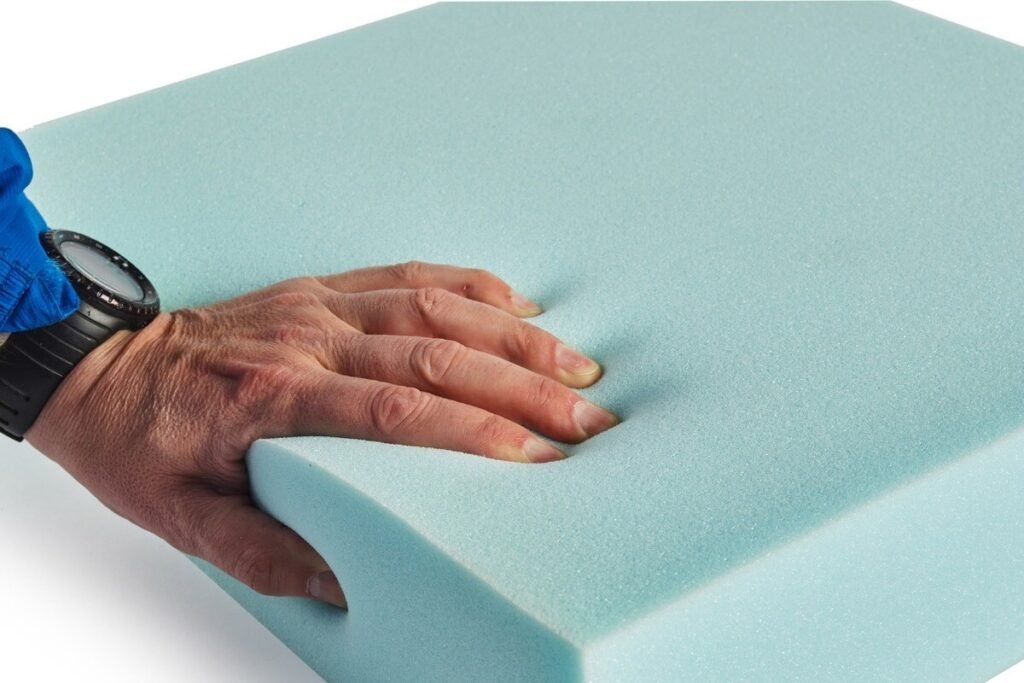
- Firmness (Feel): This is measured by ILD (Indentation Load Deflection). It tells you how soft or hard the foam feels when you first sit down.
The Pro Tip: You can have a high-density foam that is incredibly soft and plush, or a low-density foam that feels rock-hard but falls apart in a year. Always spec for high density first to ensure durability, then choose the ILD for comfort.
2. The Cheat Sheet for Seating Specs
Different parts of a chair serve different anatomical purposes. To get the perfect sit, you need to vary your density specs:
Sofa Seat Cushions (The “Workhorse”)
- Recommended Density: $30$ to $35\ kg/m^3$
- The Spec: For daily-use living room furniture, never drop below $28\ kg/m^3$. High-density foam provides the “buoyancy” needed to support body weight without bottoming out.
Back Cushions and Armrests
- Recommended Density: $20$ to $25\ kg/m^3$
- The Spec: Because your back carries significantly less weight than your hips, you can afford a lower density here. This creates that “sink-in” feeling while the seat remains supportive.
Dining Chairs and Formal Seating
- Recommended Density: $35$ to $40\ kg/m^3$
- The Spec: Dining chairs often use thinner foam pads. Because there is less material to work with, you need a very high density to prevent guests from feeling the wooden frame underneath.
3. Advanced Technology: HD vs. HR Foam
When browsing FoamsTechnology.com, you’ll encounter two primary high-performance options:
- High-Density (HD) Foam: The industry standard for reliable, structured support. Great for those who prefer a “traditional” or firm feel.
- High-Resilience (HR) Foam: The premium upgrade. HR foam has a different cell structure that offers more “spring” and a faster recovery rate. It contours to the body like memory foam but responds instantly when you stand up.
The “Sandwich” Technique: For a luxury hotel feel, pros use a base of $35\ kg/m^3$ HD foam topped with a 1-inch layer of HR foam or Memory Foam. This gives you a solid foundation with an immediate, cloud-like surface.
4. Why Density is an Economic Investment
Choosing low-density foam ($18$ to $22\ kg/m^3$) might save money upfront, but it’s a short-term gain. Low-quality foam typically fails within 12–18 months. This leads to “puddling”—where the fabric wrinkles and folds because the foam underneath has collapsed.
By insisting on 30+ density materials, you gain:
- Tailored Aesthetics: Furniture keeps its crisp, clean lines for years.
- Consistent Comfort: The “sit” feels the same on Year 10 as it did on Day 1.
- Cost Savings: You avoid the massive expense of professional reupholstery every two years.
Final Thoughts: Quality is Invisible
The best furniture is “invisible.” It supports you so perfectly that you don’t even think about it. While the fabric catches the eye, the foam catches the weight. By prioritizing high-density specifications, you aren’t just making a chair—you’re investing in long-term anatomical support