A mattress is easily one of the most used items in any household, yet it is often the most neglected. Because sleep directly influences energy levels, physical health, and spinal wellness, sleeping on a compromised foundation can slowly undermine your daily productivity.
While a standard, generic foam mattress typically serves its purpose for a limited time, material fatigue eventually sets in. But how do you separate regular wear and tear from a critical structural failure?
If you are waking up tired or wondering whether your bed has crossed its prime, here is an objective, third-party look at the signs of a declining foam mattress, what determines its true lifespan, and how market standards compare.
Read More: Who Provides the Best Foam Mattress in Pakistan?
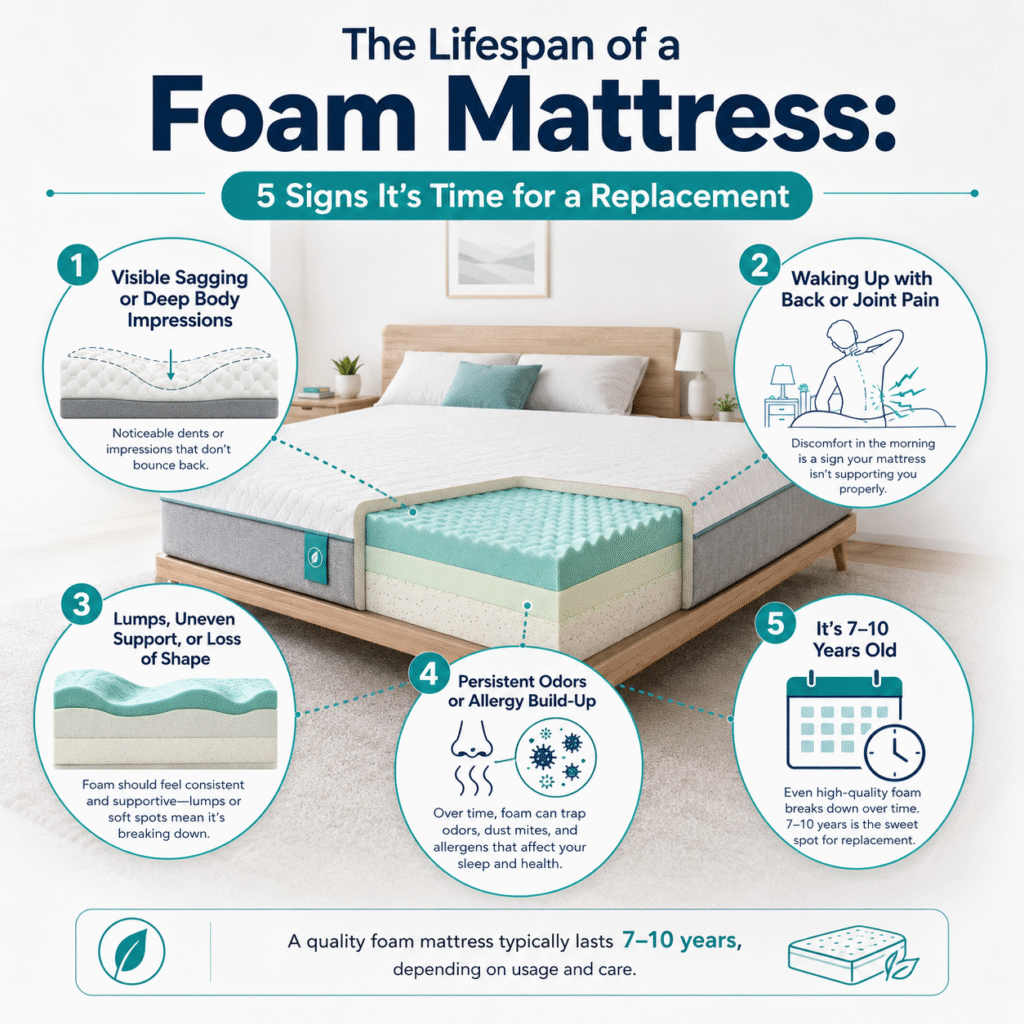
The Core Indicators: 5 Signs Your Mattress Has Expired
When evaluating your sleep setup under real-world conditions, look out for these five common physical and physiological warning signs.
1. Visible Sagging and Deep Body Impressions
A clear indicator of core breakdown is visible dipping where you typically lie. While a minor indentation is expected over time, any sag deeper than 1.5 inches indicates that the high-density support layers have permanently lost their cell resilience. This lack of resistance forces your body into an unnatural posture throughout the night.
2. Chronic Morning Aches and Back Pain
If you go to bed feeling fine but wake up with stiffness or a dull ache in your lumbar region, your mattress is no longer keeping your spine aligned. When a foam core loses its upward resistance, your heaviest zone (the hips) sinks too deep, placing continuous stress on the surrounding muscles and ligaments.
3. Accelerated Heat Retention
Low-quality or aging foam matrices tend to collapse internally, closing off the microscopic airflow paths within the material. When this structural breakdown happens, the mattress begins to act like a solid heat trap. If you find yourself waking up hot and sweaty more frequently, it is a sign the material is no longer breathable.
4. Excessive Motion Transfer and Soft Over-Flexing
High-quality foam is designed to absorb kinetic energy instantly. However, as the cellular structures within the foam degrade, the material loses its localized dampening ability. If a minor shift by a sleep partner rattles the entire surface of the bed, the core compounds have severely broken down.
5. Persistent Allergies and Dust Mite Accumulation
Old mattresses are prime targets for microscopic debris, dead skin cells, and moisture accumulation. If you find your morning congestion, sneezing, or skin sensitivities worsening without an external trigger, it often means the anti-bacterial or hypo-allergenic treatments embedded during manufacturing have worn off completely.
What Determines a Foam Mattress’s Real Lifespan?
The actual lifespan of a foam mattress boils down to structural engineering. Cheap, low-density foam options usually begin to cave within 3 to 4 years of daily use, making them a recurring expense.
When benchmarking the local market in Pakistan, the luxury tier relies heavily on high-recovery, high-density foam technology. To understand what long-term durability looks like, consider industry benchmarks like the Supreme Foam series by Diamond Supreme Foam.
Instead of basic formulas that degrade quickly under heavy weight, premium manufacturers use specialized High-Resilience (HR) compounds. These materials are engineered to rebound to their exact original height the moment pressure is released. This level of material density significantly alters the replacement timeline, pushing the functional life of a high-end bed past a decade.
Longevity Comparison Matrix
Understanding how different variations perform over time can help clarify whether your current bed is due for an upgrade.
| Mattress Type | Typical Lifespan | Primary Failure Mode | Structural Warranty Standard |
| Low-Density Utility Foam | 3–4 Years | Rapid flattening and lumping | 1–3 Years |
| Standard Open-Coil Beds | 5–7 Years | Squeaking, popping, and coil bowing | 5 Years |
| Premium High-Density Foam (e.g., Diamond Supreme Foam) | 10–12+ Years | Microscopic softening without structural collapse | Industry-Leading 12-Year Warranty |
Longevity vs. Value: Is Premium Foam Worth It?
The primary hesitation when upgrading to a market-leading option is the higher initial cost. However, a simple cost-per-year breakdown reveals that investing in low-grade options is often a financial misstep.
Replacing a low-tier mattress every three years means you end up spending more over a decade than you would on a single, high-end purchase. Furthermore, the long-term protection offered by major manufacturers changes the entire calculation. For example, a certified 12-year warranty a standard benchmark found across the premium Diamond Supreme Foam product lines, guarantees that you are purchasing over a decade of verified support, entirely neutralizing the risk of premature sagging.
Frequently Asked Questions (FAQs)
Q1: Can you extend the lifespan of an aging foam mattress with a topper?
A mattress topper can add surface comfort or cooling properties to a bed that is slightly too firm, but it cannot fix a sagging foundation. If the primary support foam underneath has already collapsed, a topper will simply follow the dip, failing to fix your spinal alignment.
Q2: Does flipping a foam mattress make it last longer?
It depends entirely on the design. Many modern, high-end foam models (such as specialized orthopedic or gel-infused cooling varieties) feature a targeted, multi-layered stack with a dedicated base layer and a specific comfort top layer. These models should never be flipped upside down. Instead, rotating the mattress 180 degrees every six months ensures even wear across the surface.
Q3: Why does Pakistan’s climate affect mattress durability?
Extreme summer heat waves, where temperatures exceed 40°C, can cause basic, low-density synthetic foams to soften and break down much faster. Opting for resilient, climate-adaptive compounds, such as high-recovery foam or gel-infused options—ensures the core maintains its structural stability despite intense seasonal temperature swings.