
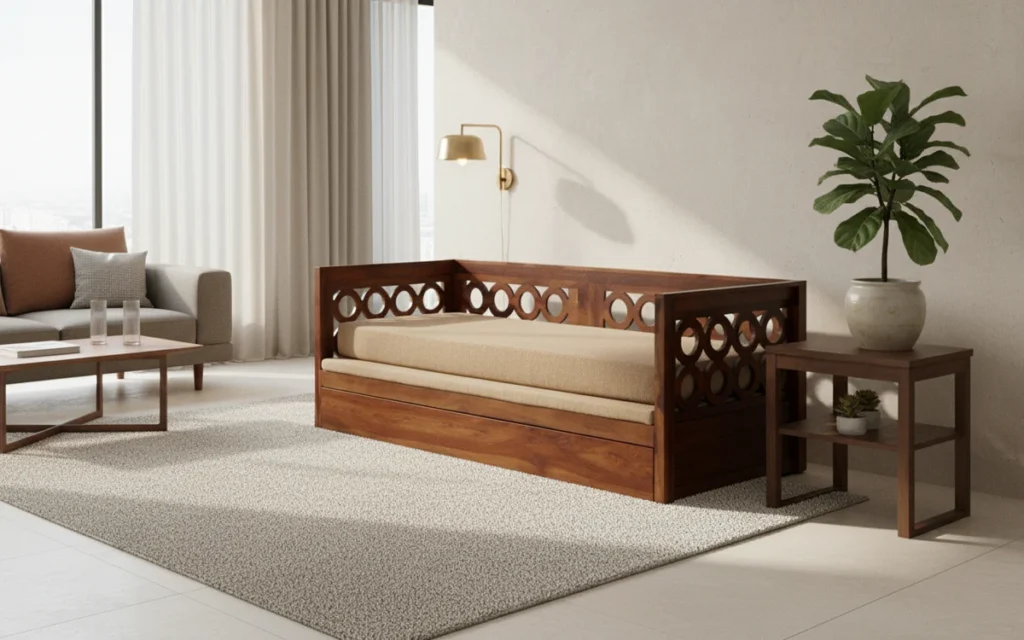
The sofa cum bed is one of the most brilliant solutions in the world of modern home decor. It’s the ultimate multi-tasker: a comfortable spot for lounging by day and a full sleeping surface by night. As urban living spaces become more compact in 2026, this space-saving furniture has transitioned from a “guest room secret” to a centerpiece of intentional, functional design.
But who actually invented the sofa cum bed? The answer is a fascinating journey through over a century of innovation, involving several inventors who reimagined how we use our square footage.
What is a Sofa Cum Bed?
In its simplest form, it is a hybrid piece of furniture that serves dual purposes. Most modern versions hide a foldable metal frame and mattress beneath the cushions, though the designs have evolved significantly. Today, the term “sofa cum bed” covers everything from:
- Pull-out Sleeper Sofas: The classic hidden frame and mattress.
- Futons: Simplified folding wooden or metal frames.
- Click-Clack Designs: A seamless mechanism where the backrest folds flat.
- Modular Sofa Beds: Sectional pieces that rearrange into a sleeping platform.
The Early Origins of Convertible Furniture
The quest for multi-functional furniture began long before the modern living room existed.
- The Folding Bed (1899): Leonard C. Bailey patented a collapsible metal bed frame originally intended for military and camping use. It proved that a bed didn’t have to be a static, heavy object.
- The Davenport (1905): Rudolf Coopersmith introduced the “Davenport bed,” which allowed a sofa to conceal a foldable mattress. This was the first major step toward bringing “hidden beds” into the mainstream living room.
Bernard Castro: The Father of the Modern Sofa Bed
While earlier patents existed, the sofa bed as we know it today was perfected by Bernard Castro in 1931. An Italian immigrant with a background in upholstery, Castro launched the “Castro Convertible” with just $400 in savings.
Castro’s genius wasn’t just in the engineering—it was in the style. Before him, convertible beds were often clunky and unattractive. Castro designed sofas that looked like high-end, stationary furniture. He famously proved the ease of his mechanism through a television campaign featuring his 4-year-old daughter, Bernadette, demonstrating that the sofa was “so easy, even a child could open it.”
Why the Sofa Cum Bed is More Relevant Than Ever
The evolution of the sofa bed mirrors the way our lives have changed. In 2026, the demand for luxury furniture in Pakistan that offers versatility is at an all-time high for several reasons:
- Space Efficiency: Urban apartments require pieces that “work for their keep.”
- The New Guest Room: Many homeowners are turning spare bedrooms into home offices, making a high-quality sofa bed the perfect hybrid solution for overnight guests.
- Technological Comfort: We have moved far beyond thin, springy mattresses. Modern sofa beds now feature high-density memory foam and “zero-clearance” mechanisms that fit perfectly in tight spaces.
Final Thoughts
The sofa cum bed is a testament to human ingenuity—a piece of furniture born from the need to make the most of our homes. From Bernard Castro’s first “Convertible” to the sculptural, automated furniture designs of 2026, it remains an essential tool for creating a versatile, welcoming interior.
As the industry continues to innovate, investing in modern home decor that offers both comfort and utility is the smartest way to ensure your home stays ahead of the curve.
FAQs
- Who is the primary inventor of the sofa bed?
While many contributed to its evolution, Bernard Castro is widely credited with inventing the modern, stylish version of the convertible sofa in 1931.
- Is a sofa bed the same as a sofa cum bed?
Yes. While “sofa bed” or “sleeper sofa” is common in the West, “sofa cum bed” is the preferred term in Asian markets. Both refer to a sofa that transforms into a sleeping surface.
- What is the most comfortable type of sofa bed in 2026?
Current trends favor modular designs and high-density memory foam pull-outs, which offer a supportive sleeping experience nearly indistinguishable from a traditional bed.